September 8, 2026
The performance of workloads on Modal depends on the performance of Modal's container filesystem. Fast cold starts rely on lazy-loading container images, so that files are only fetched when they are needed and the critical path for container startup doesn't include downloading the entire image. In addition, applications will read, write, and interact with files throughout their lifetime. This is especially true for agentic workloads, which spend much of their time doing metadata-heavy operations such as searching large codebases and loading dependencies.
This summer at Modal, I worked on improving filesystem performance for sandboxes running on gVisor, an open-source container runtime developed by Google. gVisor exposes a driver for EROFS (Enhanced Read-Only File System), a high-performance read-only Linux filesystem. Thus, a container with an EROFS root filesystem can resolve filesystem operations within the gVisor sentry, rather than traversing the host filesystem stack.
To take advantage of this, I replaced the existing filesystem path with a custom-built EROFS image that can be lazily served. By moving filesystem operations onto gVisor's faster, in-sentry EROFS path, I achieved up to 4× speedups on agentic workloads and 12× faster directory traversals, all while keeping the benefits of lazy loading for fast container cold starts.
A container image includes the operating system files, libraries, packages, and user code assembled when the image was built. An ML workload, for example, might include PyTorch, all its native dependencies, and a large Python environment. A background agent like Ramp's Inspect might include large, pre-built repositories with hundreds of pre-installed packages in its image. Most of these files will never be modified while the container is running. Thus, in order to avoid unnecessary duplication when running multiple containers on the same host, container images are shared and immutable. However, how can containers write and modify files with an immutable image? gVisor solves this by mounting the root filesystem as an overlay comprised of two layers.
The lower layer contains the files from the container image and is read-only, allowing all containers created from the same image to share the underlying data without copying it. Each container then gets its own private upper layer, which stores any files it creates or modifies. When a container modifies a file, gVisor first copies it up from the lower layer into the upper layer and modifies that private copy. For reads, gVisor checks the upper layer first, falling back to the lower layer if the file isn't there. From the container's perspective, the distinction is invisible and the two layers appear as a single, writable filesystem.
The question, then, is how to provide that read-only image layer efficiently. Downloading an entire image from object storage (Cloudflare R2, in Modal's case) and unpacking it before starting a container would be painfully slow and careless, since much of the image's contents may never be accessed. Modal instead uses a custom filesystem called ImageFS to build and serve container images. At startup, only the filesystem's metadata (stored as an ImageFS index) needs to be available; file contents can be fetched later, when an application actually reads them.
ImageFS serves image contents from a multi-tier, content-addressed cache to deduplicate shared image contents.
These bytes are served via FUSE (Filesystem
in Userspace), a Linux kernel mechanism to implement a custom filesystem in userspace without writing kernel code
or modifying the kernel. When an application issues a filesystem operation, such as open,
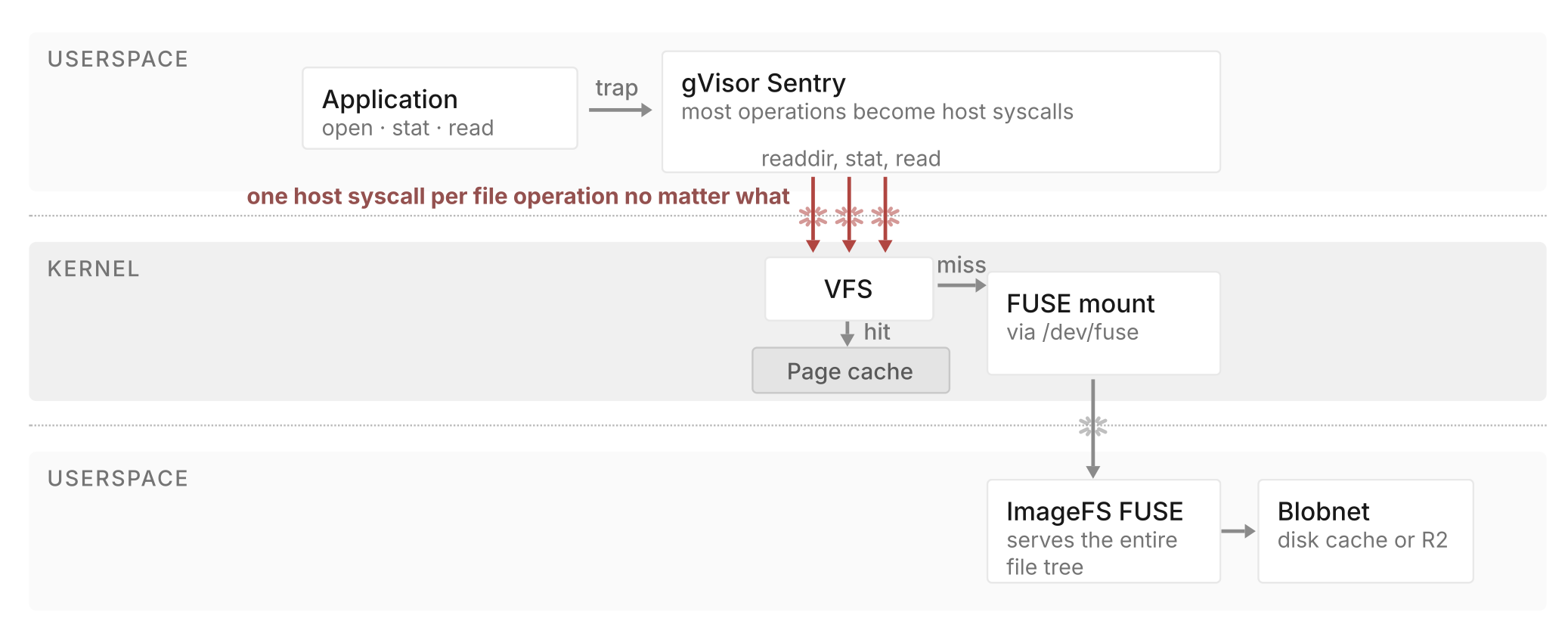
stat, read, or readdir, it traps into the gVisor sentry. To service it, the
sentry issues a host system call into the kernel's Virtual Filesystem (VFS). Traversing the host filesystem stack is
expensive because it crosses the boundary between userspace and kernel space. The gVisor sentry is implemented
entirely in userspace, and filesystem work which can be resolved entirely within the sentry is relatively cheap.
However, ImageFS doesn't stay in-sentry and instead crosses this boundary on every single filesystem
operation.
Once the request reaches the kernel VFS, it can either be serviced immediately from page cache memory, or it will hit the kernel's FUSE module and be sent to the ImageFS FUSE server, which once again crosses the boundary between kernel space and userspace (though this crossing is necessary to implement lazy image loading). This FUSE server resolves the file from Modal's Blobnet storage layer, either from local disk cache or R2 object storage.
The ImageFS architecture is well suited for large reads, where the fixed cost of a host syscall and a few context switches is small relative to the data transfer. In contrast, metadata operations do a small amount of actual work, and the cost there is dominated by traversing the host filesystem stack. Tools like package managers and coding agents recursively walk large codebases, which can require hundreds of thousands of path lookups, stats, and directory reads. With ImageFS, each small operation pays a roundtrip regardless of whether FUSE has any work to do.
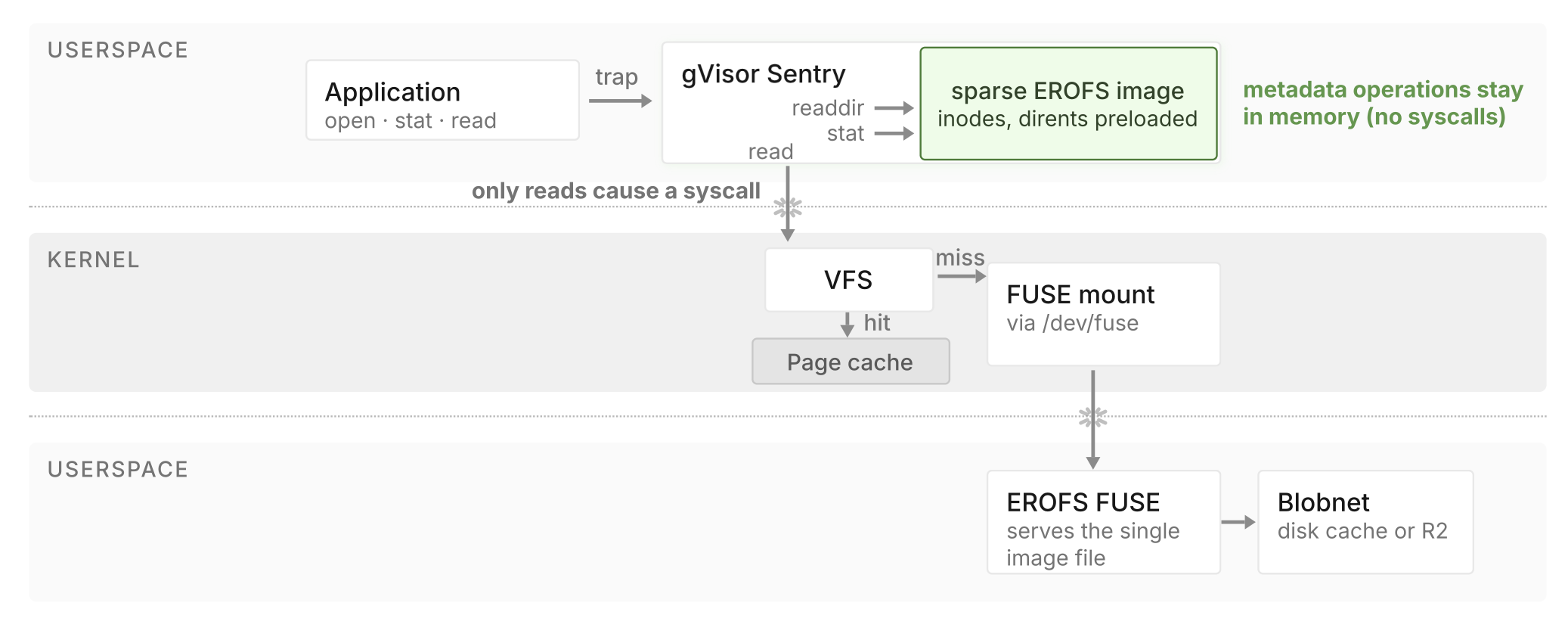
In contrast, EROFS stores a filesystem as a block-structured image which is mmapped into the gVisor
sentry. The shared and immutable container images in gVisor's lower layer are a natural fit for EROFS, a
high-performance read-only filesystem. If we convert a container image into an EROFS image and provide this to
gVisor at container startup, it can configure the overlay to have an EROFS lower layer. With this, the
sentry can parse most filesystem operations via memory
accesses on this mmapped image using its EROFS driver, thus staying entirely within userspace and avoiding an
expensive traversal over into the host.
Building the entire EROFS image at container startup is expensive, and ruins the fast cold starts we get with the
ImageFS approach. However, we can have our cake and eat it too! It turns out that gVisor only needs the EROFS
superblock at boot time, which we can determine from the small image index we use to achieve fast cold starts in
ImageFS. Instead of building the entire EROFS image, we only build a sparse image, which only has the
superblock and metadata blocks serialized, and all data blocks left empty. The time it takes to lay out and
serialize this sparse image is O(inodes), which in practice makes a negligible difference to container
cold start time.
When gVisor's EROFS driver tries to parse this sparse image, it will just read zeroes since none of the data is materialized. To fix this, we can return to our good friend FUSE once again. Rather than serving a regular filesystem, our EROFS FUSE server exposes a filesystem with only one file: the sparse EROFS image. When the gVisor driver reads the EROFS image, either it already has the bytes in page cache and can resolve everything in-sentry, or it page-faults and traverses the host filesystem stack, which will eventually hit our single-file FUSE server.
We can further take advantage of EROFS's block-formatted structure to improve performance. FUSE exposes a mechanism
called fuse_notify_store which can push bytes into page cache, so that reading those bytes can be
resolved directly from memory without requiring a syscall or a trip to the FUSE server. As a result, we can eagerly
push metadata blocks and files that we know the application will access into page cache, resulting in no host
syscalls for metadata operations.
We can also optimize building the sparse EROFS image to improve performance. I tried making this as allocation-free and copy-free as possible in the Rust implementation, since dealing with hundreds of thousands of pathname strings can get expensive if you deal with them naïvely. EROFS offers optimizations to “inline” inode tails, or store the remainder of an inode's data which doesn't fit in a full data block inline with the inode. For many directories, their data doesn't take up an entire block, so we can store the entire directory right next to its inode, which makes directory traversals much faster as we are not pointer chasing to an external block. In addition, for Modal workloads which are repeated and predictable, we can lay out the files of the sparse image in the order they will be accessed in order to improve cache locality.
After implementing the sparse image builder and EROFS FUSE server, I migrated all production gVisor sandboxes from ImageFS to EROFS by the end of my internship. The results are pretty magical: metadata-heavy workloads become much faster and we see shorter tails in p99 latency.
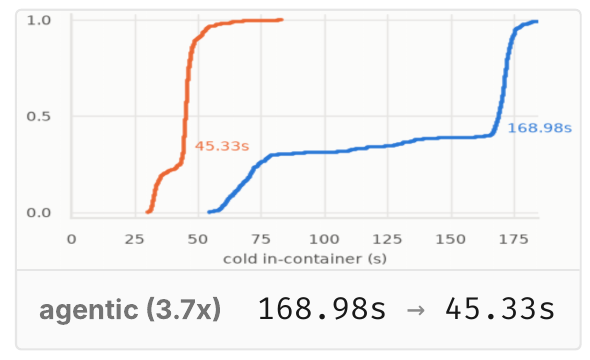
The broadest benchmark was agentic, a workload which simulates a coding agent with random greps, cats,
finds, and more on the Linux code repository. Its median runtime fell from 168.98 seconds to 45.33 seconds, a 3.7×
speedup.
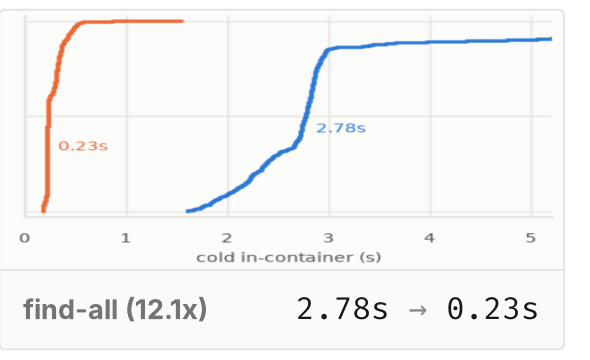
A focused filesystem tree traversal makes the improvement even clearer. The find-all benchmark searches
for files and directories within a filesystem, operations which should now stay entirely inside the sentry. Its
median runtime fell from 2.78 seconds to 0.23 seconds, a 12.1× speedup!
Other benchmarks show a similar pattern:
| Benchmark | ImageFS | EROFS | Speedup |
|---|---|---|---|
agentic |
168.98s | 45.33s | 3.7× |
chown |
15.72s | 5.59s | 2.8× |
find-all |
2.78s | 0.23s | 12.1× |
ripgrep |
9.48s | 3.53s | 2.7× |
bun install |
10.38s | 4.14s | 2.5× |
Writes have the same performance as before, since they bypass both ImageFS and EROFS and go into gVisor's upper layer. In addition, we retain performance on large read benchmarks, which are dominated by moving data and mostly exercise the FUSE path. These benchmarks ensure that the EROFS FUSE server implementation doesn't regress from the battle-tested ImageFS FUSE server.
With EROFS, we are able to keep the fast container cold starts enabled by lazy loading while significantly improving filesystem performance by avoiding unnecessary crossings between the gVisor sentry and the host filesystem stack.
Working on this project gave me an appreciation for how much performance can hide in the details, and I had a lot of fun shaving off milliseconds by avoiding allocations and optimizing byte layouts. I learned an incredible amount taking EROFS end-to-end, from sketching the initial design on a whiteboard to building and benchmarking it, working through the edge cases, and ultimately shipping it as the default in production.
I'm incredibly grateful to my team and mentors at Modal for all their guidance and support throughout the summer. Thanks for reading, and I hope you enjoyed!